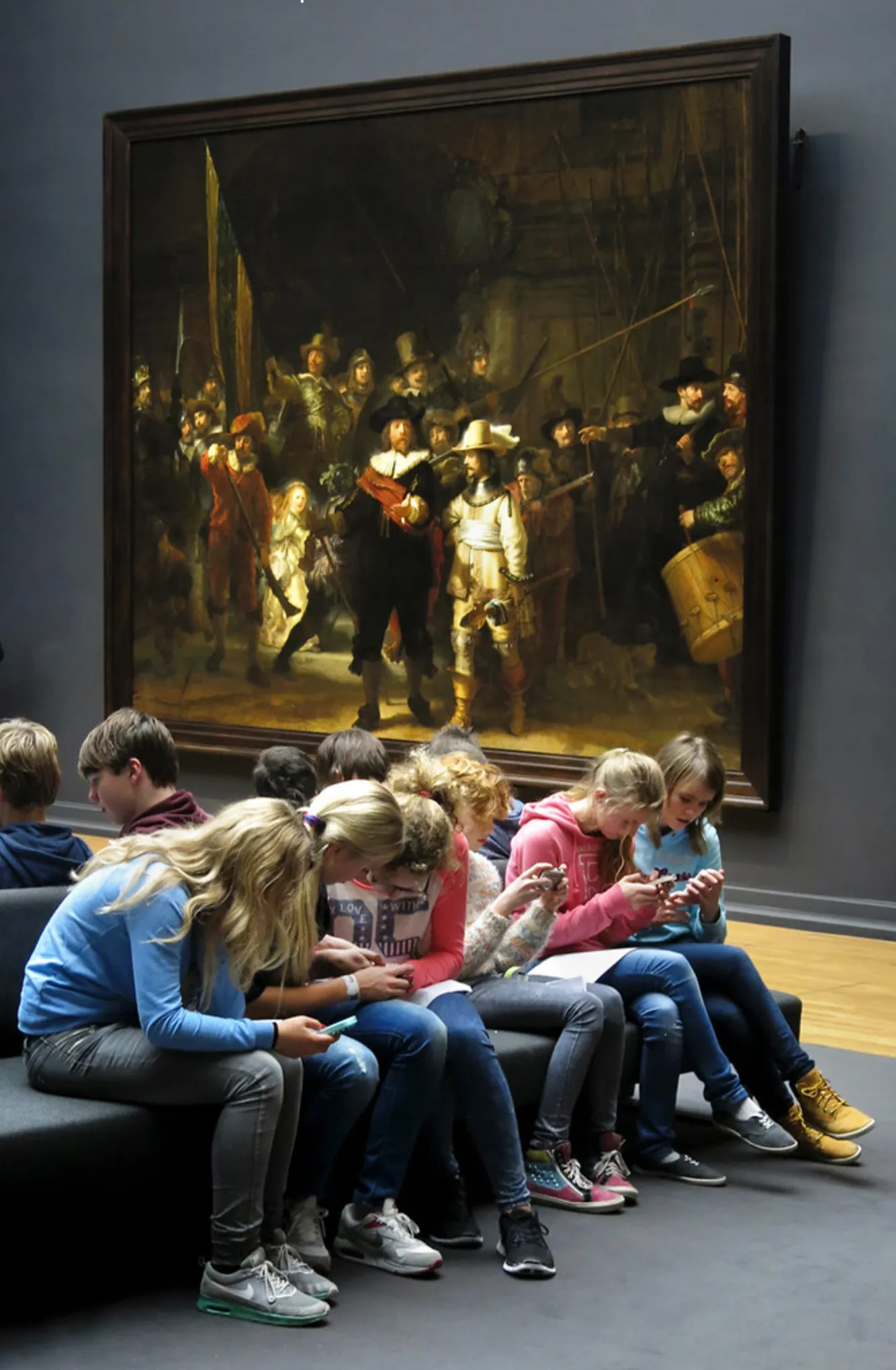
 (Photo by Gijsbert van der Wal)
In 2014, Gijsbert van der Wal photographed a group of young people, engrossed in their mobile phones, while seated in front of Rembrandt’s extraordinary painting “The Night Watch.” This image has been used to illustrate the enormous impact of mobile phones on the development of young people, who have transitioned from a childhood based on play to one based on mobile phones. The availability of all knowledge in the palm of one’s hand raises doubts in young people about the necessity of learning and memorization, a concern amplified by educational processes designed before the existence of these devices. Now, the ability to access information in natural language and to perform complex reasoning chains to answer user questions is being added. It’s easy to understand our frustration, as parents and educators, when confronted with the question, “Why should I bother if AI does it better than me?”
The book “The Anxious Generation” by Jonathan Haidt explains the impact of changes in childhood. When a child is bored, their brain enters an exploratory mode to find an interest or something new, meaning it activates curiosity. The smartphone acts as a boredom blocker, filling any void with immediate gratification. Curiosity requires concentration, what’s known as a flow state, where cognitive resources are so focused that we lose track of time. The smartphone, however, fragments attention with constant notifications and rapid content changes if the first few seconds of something don’t capture our interest. Online life has become a perpetual exam: any mistake can be shared and ridiculed. To maintain social status, it’s better not to try than to fail. We’ve created a digital system that is toxic to curiosity.
The digital childhood is having a significant effect on the young people entering our university system. Many students feel that studying is an anachronism from a time when knowledge wasn’t just a click away, and professors’ problems couldn’t be solved by AI. Edward Deci and Richard Ryan’s Self-Determination Theory postulates three basic human needs: autonomy, the feeling of having control over one’s choices, free from external pressures; competence, the sense of mastering increasingly difficult challenges; and relatedness, feeling respected and understood for the value of one’s contribution to the community. Today’s young university students have a very low tolerance for academic frustration, which destroys their sense of competence, unlike the immediate gratification experienced in their childhood. Parental oversight and control during their childhood, which continues even after they reach adulthood, stunts their autonomy. The importance placed on their digital image in their relationships with others leads to an extreme fear of making mistakes or being judged, and to placing much greater importance on the grade received than on the knowledge acquired. The constant passive consumption of content selected by algorithms results in apathy and a lack of intellectual curiosity.
David Yeager, a psychology professor at the University of Texas at Austin, has focused his work on transforming behavioral science into practical interventions to change the life trajectories of adolescents. This work is synthesized in his 2024 book, titled “10 to 25,” where he argues that educators make two mistakes when dealing with this generation of young people. The first is exercising an authoritarian, controlling mindset, which generates rebellion by thwarting a young person’s need for status and respect. The second mistake is a protective mindset, being permissive and lowering expectations, which signals to the young person a lack of confidence in their competence. For Yeager, the brain between the ages of 10 and 25 is a “respect detector.” Saying “you have to know this because it’s important for your future” or “you can’t use AI” reduces their status to obedience. The proposed solution is the mentor mindset, which combines high standards with the assurance of support. A mentor would say, “I’m giving you the challenge of mastering this complex concept without outside help because I know you’re capable of overcoming it.” For a young person to want to know or do something, it’s necessary that they feel that effort makes them an improved and respected version of themselves.
The role of education needs to shift from a focus on accumulating information to mastering agency. This means empowering young people to move from being consumers of answers to architects of questions, proving their competence and claiming the respect and status they deserve. To create young curators of information, instead of asking for a summary, we can ask them to generate AI versions and use their critical knowledge to identify the most mediocre parts. Yeager also discovered that teenagers strive harder when they feel their work serves a purpose greater than “getting a grade,” for example, when problems involve real-world situations like social justice or ethics. It is also necessary to reframe success in the age of automation: in a world where everyone has access to the same AI, the winner is the one who knows how to ask the questions no one else has asked, the one who is curious.
As parents and educators, we must realize that what’s important is the eternal value of the curious human mind, not the defense of the system in which ours developed. We should see our students not as a problem to be solved, but as a high-powered engine that needs a different fuel than what we’re accustomed to using, and that it’s worth studying what’s happening. After all, the young people in front of the Rembrandt painting weren’t playing games or on social media; they were reading about the work they had just observed, answering questions, and deepening their knowledge using the Rijksmuseum’s interactive application.